
Situation as of November 2026.
This article gives an overview of the regulations and standards that apply to an AI provider specialised in autonomous agricultural machinery, whether autonomous tractors, field robots or smart implements. They are presented as layers, from the company's internal management down to the machine operating in the field. Links to the official texts are listed at the end.

Two goals, two sets of rules
An AI provider in this field has to answer two different questions. The first is about the company: how it develops, governs and documents its AI. This is what customers, auditors and, increasingly, regulators expect from an organisation. The second is about the product: whether the machine its software runs on is safe and can legally be sold.
Legally, the second question belongs to the machine manufacturer, who certifies the machine and places it on the market. But the AI provider's software is often what makes the machine autonomous, so the manufacturer passes the requirements down: safety evidence, test results, documentation. In practice, the AI provider has to meet both sets of rules.
The layers below follow that path, from the organisation to the machine in the field, each with the laws and standards that apply to it. Layer 1 concerns the company, layers 3 and 5 the machine, and layers 2 and 4, risk and cybersecurity, are split between the two.
Layer 1: the organisation
Everything starts with how the company manages AI and information. ISO/IEC 42001 defines an AI management system: roles, policies, lifecycle controls. It's certifiable, and increasingly asked for by OEM customers. ISO/IEC 27001 does the same for information security.
Regulation will eventually require this too. The AI Act (2024/1689) asks providers of high-risk AI to run a quality management system. For AI built into machines, however, this obligation won't come from the AI Act itself: since the Digital Omnibus on AI (2026/1744), the AI Act's requirements for these products are to be added to machinery law instead.
This layer is about trust in the company rather than the safety of a machine. It's where traceability, data governance and accountability are built, and the product layers rely on them.
Note (November 2026): the delegated acts adding AI requirements to machinery law are expected by August 2028. EN 18286, the European quality management standard written for the AI Act, was approved in July 2026 but is not yet cited in the Official Journal; whether it will be used for machinery is not settled.
Layer 2: risk, for the company and for the machine
Risk appears on both sides, with different questions and different standards.
For the company, the question is what can go wrong with the AI it develops and the information it handles. ISO/IEC 23894 gives guidance on AI risk management, built on ISO 31000: biased data, model drift, misuse. ISO/IEC 27005 does the same for information security risks.
For the machine, the question is physical: can it hurt someone? ISO 12100, the foundation of all machinery safety, sets the method: identify hazards, then reduce the risk by design, guarding and information. Machinery law requires this assessment: the Machinery Regulation (2023/1230) and Regulation 167/2013 for tractors. The AI component will add its own requirements once the AI Act's risk management rules are imported into machinery law.
The two meet on concrete cases: a missed obstacle detection is both an AI risk for the company and a hazard for the machine. Keeping the analyses separate is fine, as long as each feeds the other.
Note (November 2026): the Machinery Regulation applies from 20 January 2027. prEN 18228, the European AI risk management standard written for the AI Act, is still a draft.
Layer 3: safety of the AI function
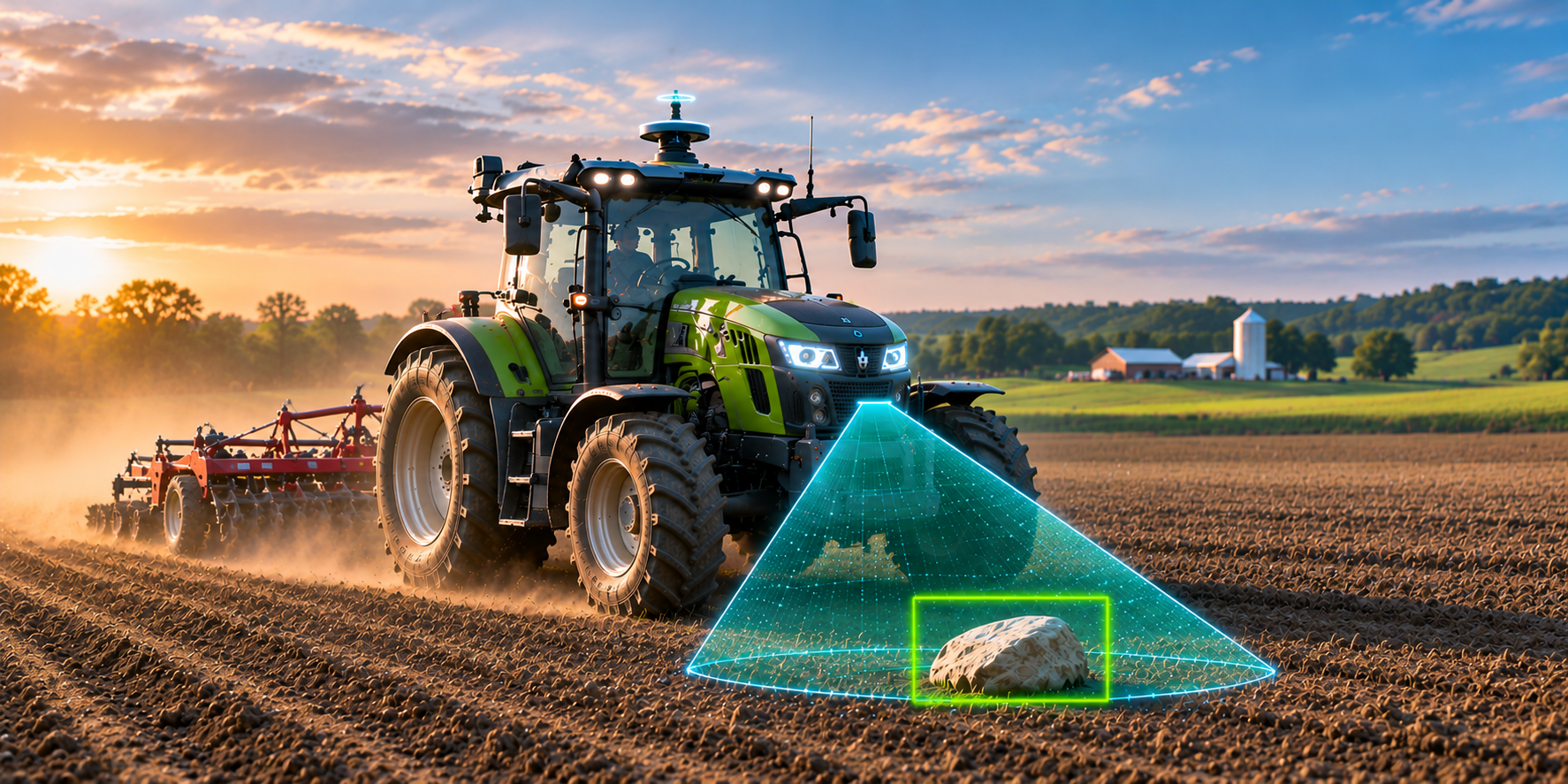
Two families of standards make sure a perception function is safe: one deals with failures, the other with errors that happen without any failure.
Functional safety: handling failures
When perception contributes to a safety function, functional safety standards apply. For agricultural machinery, the reference is ISO 25119, which sets performance levels and software development requirements. It's adapted from automotive ISO 26262 and the general machinery standard ISO 13849, which remains relevant for field robots and carriers that aren't approved as tractors.
In the EU, functional safety is part of tractor type approval (Delegated Regulation 2015/208); for other machines, it falls under the Machinery Regulation's essential requirements.
The limitation is well known: these standards were designed for deterministic systems. They tell you how to handle a failing sensor or a crashing processor. They say little about a neural network that works perfectly and still gets it wrong.
Perception and embedded AI: handling performance limits
That's exactly the gap the next standards address. ISO 21448 (SOTIF) deals with hazards that arise without any failure: a person partially hidden by leaves, dust, low sun, an unusual posture. Its concepts of triggering conditions and unknown unsafe scenarios map almost one-to-one onto agricultural perception.
ISO/PAS 8800 goes further and defines a safety lifecycle for AI components: data requirements, model verification, monitoring in operation. Both were written for road vehicles, and both transfer well to the field. They're complemented by ISO/IEC 5259 on data quality for machine learning and ISO/IEC 24029 on neural network robustness, which help justify training and test datasets.
There is no agricultural equivalent of ISO/PAS 8800 yet. For now, providers have to borrow from automotive and argue the transfer themselves.
Note (November 2026): ISO/PAS 8800 is a provisional specification, already scheduled for revision.
Layer 4: cybersecurity, for the company and for the machine
A compromised perception system is a safety problem, not just an IT problem. Like risk, cybersecurity concerns both the company and the machine.
For the company, ISO/IEC 27001 (Layer 1) covers information security as a whole. IEC 62443-4-1 goes further for product makers: it defines a secure development process, from threat modelling to the handling of vulnerabilities after release.
For the machine, the Cyber Resilience Act (2024/2847) sets cybersecurity requirements for every product with digital elements, whether a tractor, a field robot or a smart implement, and its software. IEC 62443-4-2 sets technical security requirements for components. A standard dedicated to agricultural machines is on its way.
Note (November 2026): ISO 24882, the cybersecurity standard for agricultural machinery, is still a draft. It adapts the automotive ISO/SAE 21434 approach to machines that may work for long periods without connectivity.
Layer 5: in the field
Finally, the machine itself. The Machinery Regulation is the first EU law with explicit requirements for autonomous mobile machinery, including remote supervision. ISO 18497, revised in 2024 into a four-part series, is the dedicated standard for automated and autonomous agricultural machinery. Part 2 covers obstacle protection systems, which is the perception component itself. Part 4 covers verification and validation, which is how that component will be judged. For an AI perception provider, these are probably the most directly relevant pages in the whole stack.
Around it, ISO 11783 (ISOBUS) governs how the tractor and implements communicate, which matters as soon as perception has to command or stop an implement.
What remains open
The most mature parts of this map are at both ends: management systems and risk assessment on one side, machinery safety on the other. The part in between, where AI makes safety decisions in an agricultural machine, has no dedicated agricultural standard yet. Providers rely on automotive standards (ISO 21448, ISO/PAS 8800) and on ISO 18497 for testing, while the legal requirements for AI in machinery are expected from the 2028 delegated acts.
No single standard covers the whole chain. Compliance comes from how the layers fit together, from the management system down to the machine in the field.
References
EU legislation (EUR-Lex)
- AI Act – Regulation (EU) 2024/1689
- Digital Omnibus on AI – Regulation (EU) 2026/1744
- Machinery Regulation – Regulation (EU) 2023/1230
- Agricultural and forestry vehicles – Regulation (EU) No 167/2013
- Cyber Resilience Act – Regulation (EU) 2024/2847
ISO standards (iso.org)
- ISO/IEC 42001:2023 – AI management systems
- ISO/IEC 23894:2023 – AI risk management guidance
- ISO/IEC 27001:2022 – Information security management
- ISO 12100:2010 – Safety of machinery, risk assessment
- ISO 13849-1:2023 – Safety-related parts of control systems
- ISO 25119-1:2018 – Agricultural control systems, functional safety
- ISO 26262-1:2018 – Road vehicles, functional safety
- ISO 21448:2022 – Safety of the intended functionality (SOTIF)
- ISO/PAS 8800:2024 – Road vehicles, safety and AI
- ISO 18497-1:2024 – Autonomous agricultural machinery, design principles
- ISO 18497-2:2024 – Obstacle protection systems
- ISO 18497-4:2024 – Verification and validation